


How can variations in stitching techniques be used to enhance the overall texture and aesthetics when making knitted cardigans?
Release Time : 2026-02-06
When making knitted cardigans, variations in stitch patterns are key to enhancing the overall texture and aesthetics. Combining and applying different stitches not only enriches the texture of the fabric surface but also strengthens structural stability, optimizes wearing comfort, and even imbues the cardigan with a unique stylistic language. From basic stitches to complex patterns, every detail must be closely integrated with the fabric characteristics, design theme, and wearing occasion to achieve a dual enhancement of texture and beauty.
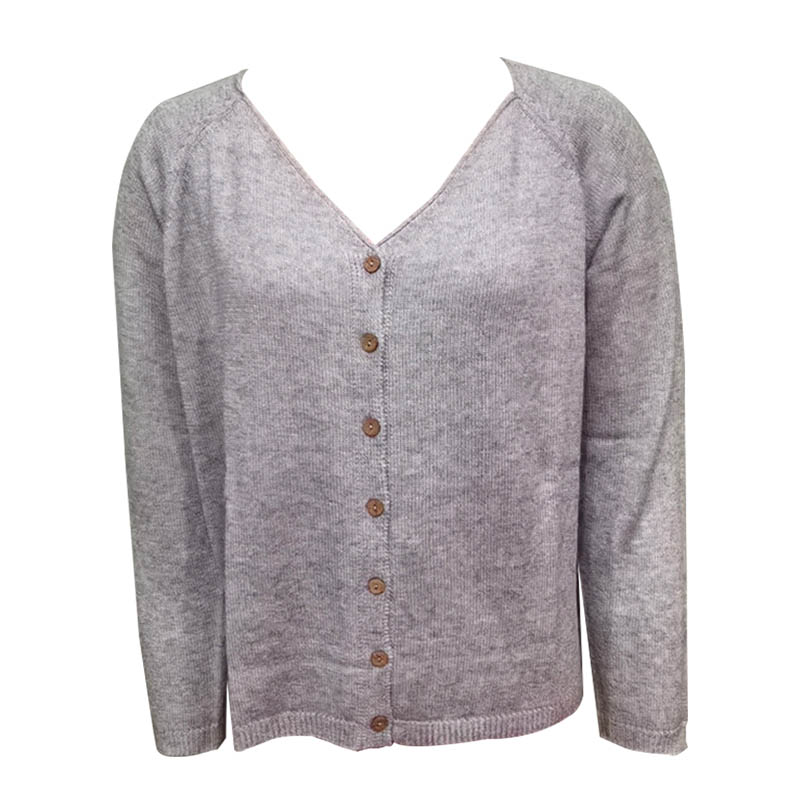
The choice of basic stitches for knitted cardigans is the cornerstone of texture. Plain knit (stockinous stitch), due to its flat and tight characteristics, is often used in the main body of the cardigan, such as the front, back, and sleeves, creating a clean and crisp visual effect while ensuring the fabric's crispness and resistance to deformation. Ribbed knit is mostly used at the neckline, cuffs, and hem. Through alternating knit and purl stitches, it forms an elastic band that conforms to the body's curves and prevents the edges from loosening and deforming. For example, fine-gauge ribbing creates a sophisticated feel, suitable for spring/summer cardigans paired with lightweight yarns; while coarse-gauge ribbing offers a more casual and relaxed look, perfect for autumn/winter pieces when combined with heavier yarns like wool.
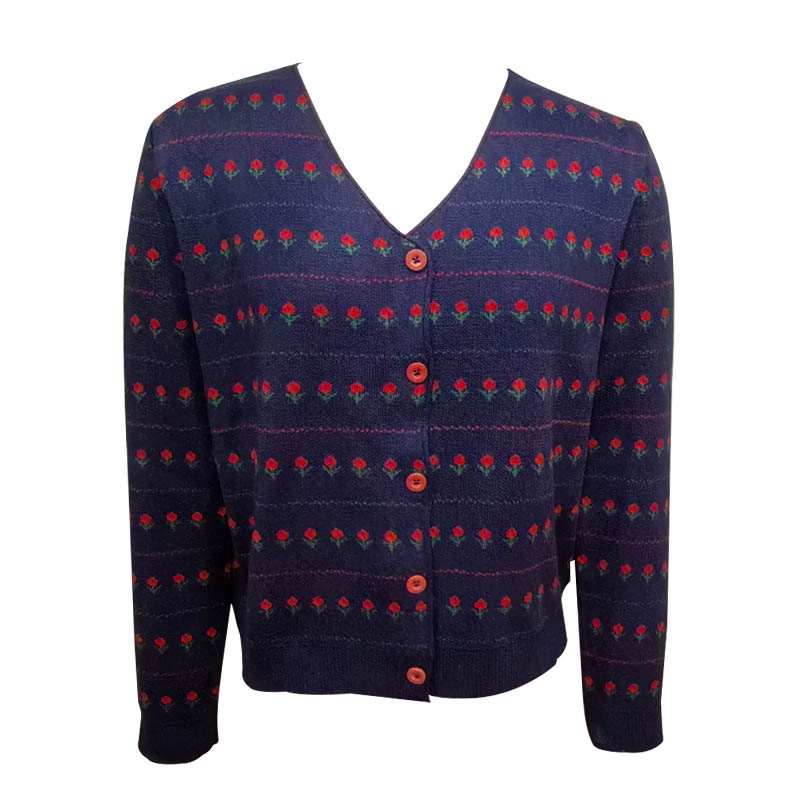
Jacquard knitting is a key technique for enhancing aesthetics. By using contrasting yarns in different rows or areas, geometric patterns, floral designs, or abstract lines can be created, injecting an artistic touch into the cardigan. The complexity of the jacquard pattern needs to be matched to the yarn thickness—fine yarns are suitable for delicate small patterns, such as polka dots, stripes, or small geometric blocks; coarse yarns are better suited for large blocks of color or bold ethnic patterns. Furthermore, controlling the density of the jacquard stitch is crucial; too dense a jacquard will result in stiff fabric, while too sparse may affect the clarity of the pattern. A balance must be found by adjusting the stitch length and yarn tension.
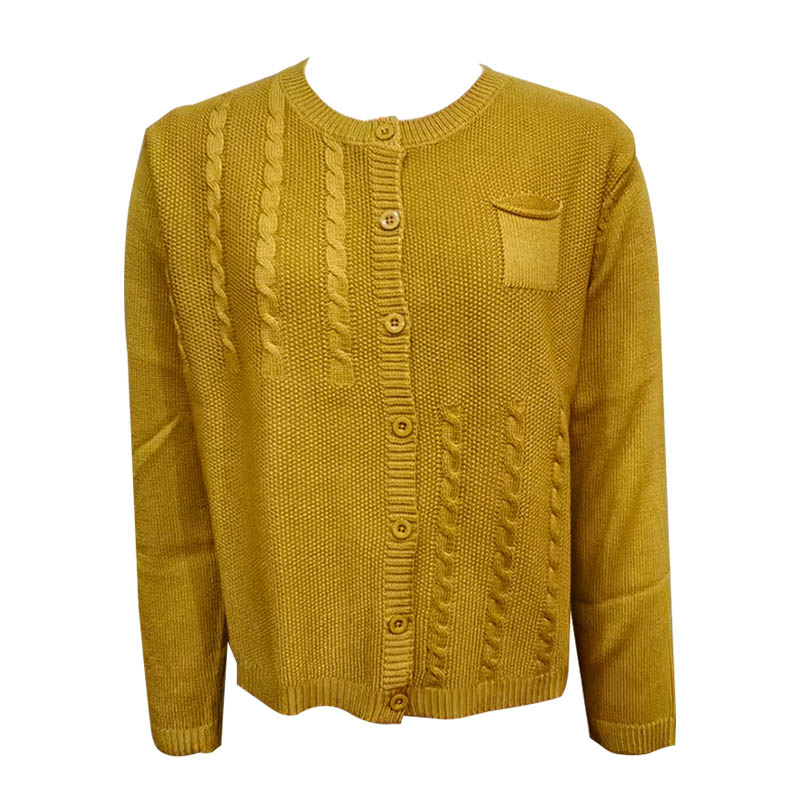
Nitted cardigan (or twill) knitting gives cardigans a three-dimensional and handcrafted feel. By interlacing adjacent stitches, a raised, knot-like texture is created, mimicking the classic pattern of traditional Alain sweaters. The application of cable knit requires consideration of the fabric's thickness and elasticity—cable knits made with fine yarns appear more delicate and are suitable for fitted styles; cable knits made with thicker yarns have a greater presence and can be combined with looser styles to create a relaxed atmosphere. At the same time, the arrangement of the cable knits should also follow design logic; for example, symmetrical arrangements are suitable for formal occasions, while irregular arrangements appear more casual.
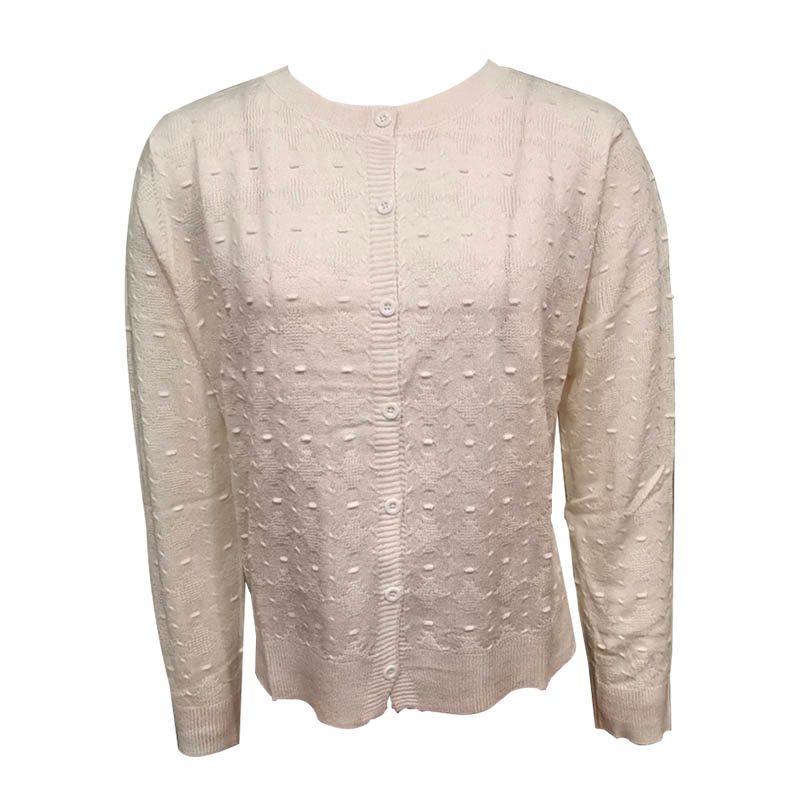
Nitted cardigan (openwork stitch) creates a lightweight and breathable visual effect, especially suitable for spring and summer cardigans. By strategically leaving some stitches unknitted, holes or mesh structures are created, reducing fabric weight and adding layers. The application of openwork stitch requires consideration of yarn characteristics—natural fiber yarns such as cotton and linen are highly absorbent, and the openwork sections are easily deformed by stretching, requiring increased stitch density or the addition of elastic fibers to enhance stability; while synthetic fiber yarns, due to their good elasticity, are more suitable for complex openwork designs. Furthermore, the density of openwork patterns should match the wearing occasion—dense small holes are suitable for commuting, while large holes are more suitable for a vacation style.
Combined stitches can break the monotony of a single stitch. For example, combining plain stitch with cable knit, using plain stitch on the main body to ensure crispness, and adding cable knit decorations to the cuffs or front edges to create a visual focal point; or combining jacquard with openwork, incorporating mesh design at color block splicing points to increase layering. The application of combined stitches should follow the principle of "distinction between primary and secondary elements" to avoid clutter due to too many elements. Usually, one stitch is primary, and another is secondary, achieving a harmonious aesthetic through proportional control.
Edge treatment is a detailed extension of stitch variation. The collar, cuffs, and hem of a cardigan can be finished with different stitches, such as decorative stitches like picot stitch, shell stitch, or Iceland stitch, which can both strengthen the edge structure and enhance the sophistication. The choice of edge stitching should echo the main stitching—if the main body is plain knit, the edge can be finished with rib; if the main body is jacquard, the edge can continue the jacquard pattern or use contrasting yarns to weave a simple lace.
Stitch variations also need to coordinate with the pattern design. Slim fits are suitable for delicate stitches, such as fine-pitch plain knit or small jacquard, to emphasize the lines; loose fits are suitable for thick-pitch cable knit or large openwork, enhancing the relaxed atmosphere. At the same time, the stitch density must match the yarn thickness—thick yarns require looser stitches to avoid stiffness, while thin yarns require tighter stitches to ensure crispness. Through the interaction between stitching and pattern, a complete expression from structure to style can be achieved.